by MMBB Financial Planning Specialist Tyler Howard, CFP®, MBA, RICP®
What's in This Article?
- What Is the Impact on the Clergyperson
- How Compensation Mistakes Affect the Church Administrator
- Why Errors Impact the Church
Clergy compensation sits at a unique and often confusing intersection of tax law, ministry calling, and faithful stewardship. Ordained ministers generally hold dual status under IRS rules: they are employees for federal income tax purposes but self-employed for Social Security and Medicare under the Self-Employment Contributions Act (SECA). Add the special housing allowance available under Section 107 of the tax code, and even the most well-intentioned churches and pastors can find themselves navigating unexpected complexity. When compensation is structured incompletely or incorrectly, the consequences affect not just the pastor but also the pastor’s family, the church administrator’s daily work, and the church’s ability to care for those who serve it.
What Is the Impact on the Clergyperson
For the clergyperson, the impact is deeply personal. A housing allowance that is not properly designated in writing by the church board before the year begins cannot be excluded from taxable income. That one missing step can quietly add thousands of dollars to a pastor’s tax bill.
Even when the allowance is designated correctly, it remains subject to the full 15.3 percent SECA tax.1 Without thoughtful planning for estimated payments or voluntary withholding that covers both income tax and SECA, many ministers discover a painful surprise each spring. Over time, these gaps can also affect retirement readiness. Because clergy typically receive no employer FICA match, they carry the full Social Security burden themselves. When retirement contributions fall short or funds are later moved in ways that lose the housing-allowance benefit, pastors may find themselves less prepared than they hoped for later in life and ministry. Financial strain rarely stays confined to spreadsheets—it can weigh on a pastor’s peace of mind, family life, and capacity to serve with joy.
How Compensation Mistakes Affect the Church Administrator
Church administrators often carry a quiet load as well. Some may serve as volunteers or part-time staff without specialized training in the unique rules that apply to ministers. When a pastor is treated like a regular employee (for example, with FICA withheld incorrectly) or when expense reimbursements are not handled under an accountable plan, the administrator is left to untangle the results—amended forms, correspondence with the IRS, and time-consuming corrections.
Why Errors Impact the Church
These situations can also create liability concerns for the church and those involved in approving compensation. What begins as a desire to serve the church well can become a source of stress and uncertainty. Administrators who simply want to support their pastor and keep the church compliant deserve clear guidance and reliable systems so their energy can stay focused on ministry rather than cleanup. To serve administrators, clergy and churches, MMBB provides resources about clergy compensation, including the housing allowance and reimbursement expense accounts, on its website.
The church itself feels the effects most broadly. Resources spent on penalties, interest, professional fees, or correcting past mistakes are resources no longer available for outreach, pastoral care, or the everyday work of serving the congregation. Poorly structured compensation can also make it harder to attract and retain faithful clergy. When pastors feel the weight of unexpected tax burdens or underfunded benefits, they may eventually seek another call, leaving the church to navigate the cost and disruption of the transition.
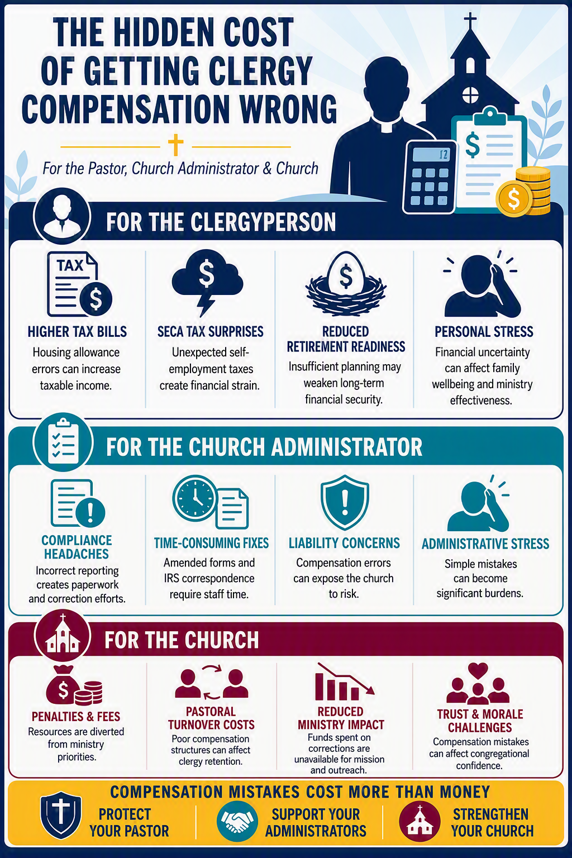
Beyond the numbers, there is a quieter cost to trust and morale. Congregations want to honor their shepherds well. When compensation is handled with care and clarity, that desire is fulfilled. When it is not, even unintentional missteps can leave everyone feeling unsettled.
Getting clergy compensation right is one of the most practical ways a church can express care for its pastor, support its administrators, and steward its resources faithfully. Clearly written housing-allowance designations, accountable reimbursement plans, accurate dual-status reporting, thoughtful SECA planning (often including a taxable offset), and adequate retirement contributions make a meaningful difference. Regular review with people who understand the unique rules for clergy helps protect everyone involved. When compensation is handled with both knowledge and heart, the hidden costs fade—and pastors, administrators, and churches are freer to focus on the work God has called them to do together.
Sources:
- https://www.irs.gov/businesses/small-businesses-self-employed/self-employment-tax-social-security-and-medicare-taxes
The information contained herein is for informational purposes only. While MMBB made every attempt to ensure that the information is accurate, MMBB is not responsible for any errors or omissions or the results obtained from the use of this information. MMBB is not liable for any success or failure that is directly or indirectly related to the use of the information contained herein. The information contained herein does not constitute any financial, insurance, investment, legal, or tax advice. The inclusion of any third party links does not constitute an endorsement. In no event shall, MMBB and/or its fiduciaries, directors, officers, employees, or agents thereof be liable for any special, direct, indirect, consequential, or incidental damages or any damages whatsoever, whether in action of contract, negligence or tort, arising out of or in connection with the use of the information contained herein.
This article is available in audio format through our text-to-speech feature for accessibility and convenience. The text-to-speech feature is generated using artificial intelligence. While we strive for an accurate listening experience, this information may be incomplete or inaccurate. Please refer to the written version as the official source of content. This content should not be relied upon as a substitute for professional advice.
Images displayed in this material were created in whole or in part by generative artificial intelligence (AI) and are provided for illustrative purposes only. They may contain errors or inaccuracies and should not be relied upon as a substitute for professional advice. They are not intended to represent real individuals, organizations, or events.