










by Rev. Dr. William H. Foster, Jr., MBA, DMin, MDiv, MMBB Director, Marketing & Strategic Relationships
What's in this Article
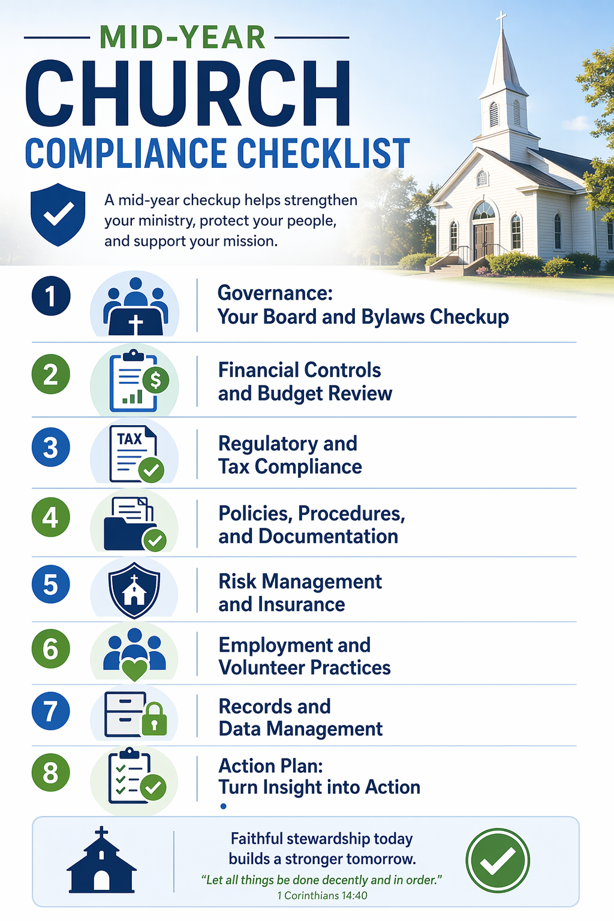
Eight key parts of a church checklist:
1. Governance: Start with Leadership and Accountability
2. Financial Controls: Strengthen Transparency and Oversight
3. Regulatory and Tax Compliance: Stay Current and Documented
4. Policies and Procedures: Ensure Clarity and Consistency
5. Risk Management and Insurance: Protect What Matters Most
6. Employment and Volunteer Practices: Care for Your People
7. Records and Data Management: Strengthen Your Foundation
8. From Insight to Action: Make the Review Count
For churches, compliance is not merely a legal obligation—it is an expression of faithful leadership. In 1 Corinthians 4:2, Paul reminds us, “Now it is required that those who have been given a trust must prove faithful” (NIV). This call to faithfulness extends to how church leaders steward financial resources, people, and operations with integrity and care.
Compliance with laws, regulations, industry standards, and internal policies is more than administrative—it is a safeguard that protects your church’s mission, staff, congregation, and resources.
As we reach the middle of the year, church leaders have a valuable opportunity to pause and assess. A mid-year compliance review helps identify gaps early, allowing your ministry to remain aligned with its mission and values—while avoiding last-minute challenges at year-end. One of the most effective ways to guide this process is through a structured compliance checklist.
Below are eight key areas every church should revisit this season:
1. Governance: Start with Leadership and Accountability
Healthy governance is the foundation of compliance. Review your board structure to ensure roles and responsibilities are clearly defined and that potential conflicts of interest are disclosed and managed.
Confirm that board meetings are held regularly and properly documented. Your bylaws should be clear, current, and consistently followed—serving as a guide for accountability and decision-making.
2. Financial Controls: Strengthen Transparency and Oversight
Strong financial practices protect both your resources and your reputation. Evaluate whether duties are appropriately separated so that no single person controls all financial processes.
At mid-year, take time to compare actual spending against your approved budget. Adjust for changes in giving patterns or ministry priorities to ensure financial decisions remain aligned with your mission.
3. Regulatory and Tax Compliance: Stay Current and Documented
Compliance with federal, state, and local requirements is essential. Review key obligations such as tax filings, employee classifications, and clergy compensation practices.
Equally important is maintaining clear documentation of major decisions and filings. Staying current now helps prevent costly complications later.
4. Policies and Procedures: Ensure Clarity and Consistency
Well-documented policies promote accountability and continuity across your ministry. Review your financial policies, spending procedures, and conflict-of-interest guidelines to ensure they are up to date.
Just as critical, confirm that staff and key volunteers understand and follow these policies in their daily responsibilities.
5. Risk Management and Insurance: Protect What Matters Most
Insurance is a critical component of your church’s risk management strategy. Evaluate whether your current coverage remains adequate, including general liability, property, workers’ compensation, and Directors and Officers (D&O) insurance. See our article on the types of insurance every church should consider.
As ministries expand and adopt new technologies, also consider emerging risks related to events, digital tools, and data security. Mid-year is an ideal time to ensure your coverage evolves alongside your ministry.
6. Employment and Volunteer Practices: Care for Your People
Your staff and volunteers are among your greatest assets. Review compensation practices, background check procedures, and safety protocols to ensure they reflect current standards.
This is also a good time to confirm your employee handbook is up to date and aligned with your church’s policies and expectations.
7. Records and Data Management: Strengthen Your Foundation
Accurate recordkeeping supports both compliance and effective decision-making. Evaluate how your church maintains financial records, donor data, and governance documentation.
Ensure retention policies are followed and that data privacy practices are strong—particularly as churches increasingly rely on digital systems.
8. From Insight to Action: Make the Review Count
A mid-year review is only valuable if it leads to action. Consider turning your checklist into a working document for your leadership team—or scheduling a mid-year review meeting to begin the process together.
Identify key gaps and develop a clear plan to address them—prioritizing both immediate needs and longer-term improvements. Assign ownership to appropriate leaders or committees, and ensure next steps are realistic, measurable, and achievable.
Faithful Stewardship in Action
Church compliance is not simply about reviewing a checklist—it is a reflection of faithful stewardship. By taking a proactive approach, churches can move from reactive problem-solving to intentional, mission-driven leadership.
When stewardship is strong, trust is strengthened. And when trust is strengthened, ministry can flourish.
The information contained herein is for informational purposes only. While MMBB made every attempt to ensure that the information is accurate, MMBB is not responsible for any errors or omissions or the results obtained from the use of this information. MMBB is not liable for any success or failure that is directly or indirectly related to the use of the information contained herein. The information contained herein does not constitute any financial, insurance, investment, legal, or tax advice. In no event shall, MMBB and/or its fiduciaries, directors, officers, employees, or agents thereof be liable for any special, direct, indirect, consequential, or incidental damages or any damages whatsoever, whether in action of contract, negligence or tort, arising out of or in connection with the use of the information contained herein.
This article is available in audio format through our text-to-speech feature for accessibility and convenience. The text-to-speech feature is generated using artificial intelligence. While we strive for an accurate listening experience, this information may be incomplete or inaccurate. Please refer to the written version as the official source of content. This content should not be relied upon as a substitute for professional advice.
Images displayed in this material were created in whole or in part by generative artificial intelligence (AI) and are provided for illustrative purposes only. They may contain errors or inaccuracies and should not be relied upon as a substitute for professional advice. They are not intended to represent real individuals, organizations, or events.